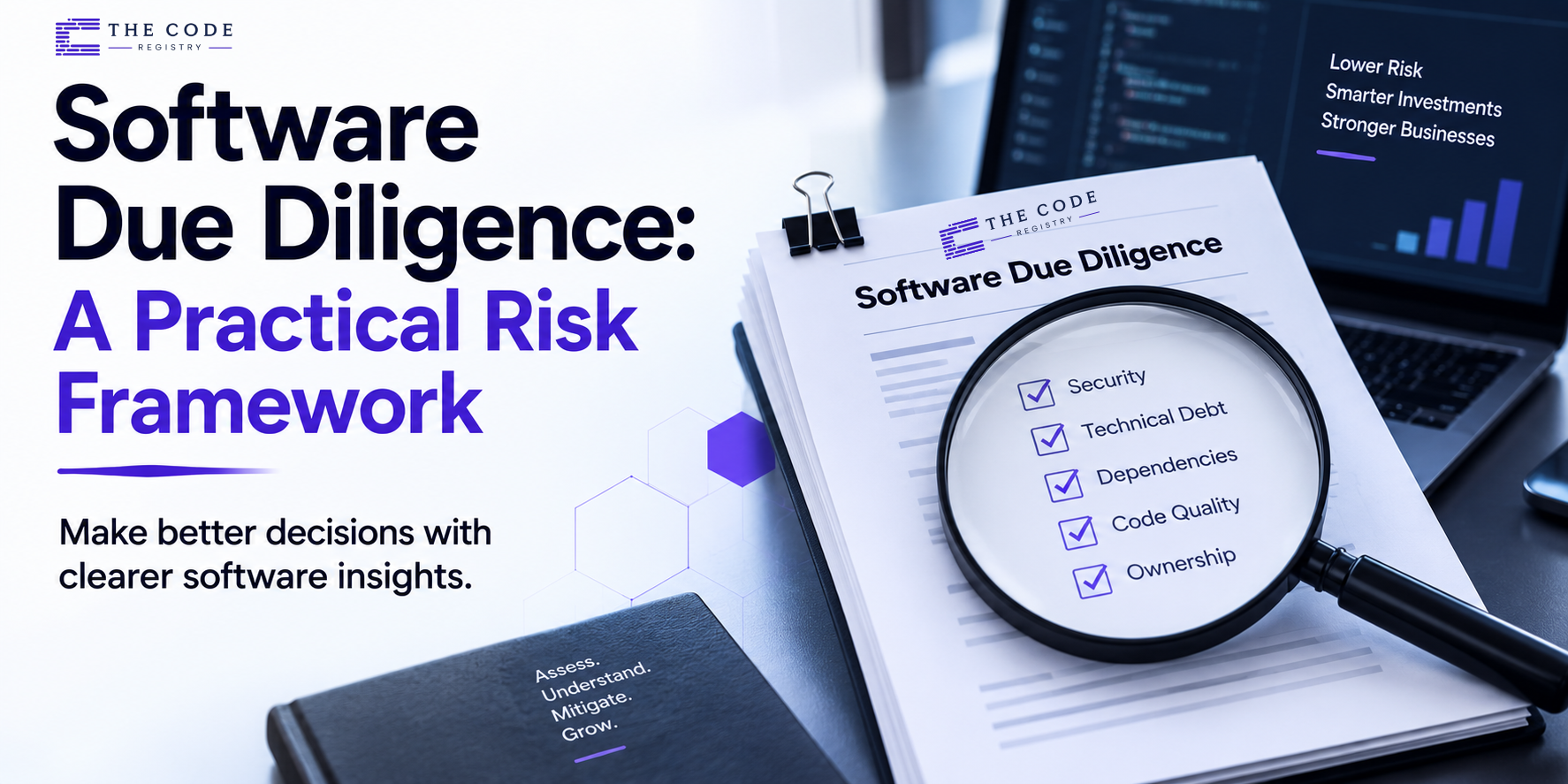
A Practical Framework for Software Due Diligence
How to Identify and Assess Hidden Software Risks Before They Impact Your Business
Every production codebase is an iceberg. What ships to production is rarely just the clean, modular code written by your core team over the last few sprints. In reality, modern enterprise software is an assembled composite of open-source packages, transitively resolved libraries, legacy glue code, third-party SDKs, and code authored or refactored by AI coding agents.
Traditional Security Scan          Software Due Diligence
┌─────────────────────────┐        ┌──────────────────────────────────────────────────────────┐
│ Known Vulnerabilities   │        │ Composition • Provenance • Dependencies • Architecture   │
│ (CVEs, static alerts)   │   vs   │ Maintainability • Technical Debt • Ownership • Licensing │
│                         │        │ Governance • AI Lineage • Operational Resilience         │
└─────────────────────────┘        └──────────────────────────────────────────────────────────┘
Result: Flawed clean bill          Result: Defensible, multi-dimensional risk evidence
When engineering leaders evaluate a software asset — during an acquisition, before onboarding an enterprise vendor, or when taking ownership of an inherited system — the default playbook is flawed: run a software composition analysis (SCA) scanner, count the Common Vulnerabilities and Exposures (CVEs), and spot-check a few critical pull requests.
A clean vulnerability report confirms that known bugs are absent; it does not confirm that sound architecture, clear ownership, and maintainable engineering are present.
Evaluating an asset without manually reading millions of lines of code requires evaluating the structural chain of evidence that connects raw source code to long-term enterprise viability.
Executive Summary
Due Diligence Transcends Vulnerability Scanning: A zero-CVE scan does not mean low risk. It ignores architecture coupling, abandoned upstream dependencies, and cognitive debt.
Provenance Is Non-Negotiable: If you cannot verify who wrote a module, how it was built, or its cryptographic chain of custody, you do not have an auditable asset.
Dependencies Dictate Blast Radius: Up to 90% of your binary lives in third-party libraries. A single unmaintained transitive package can stall your roadmap.
Architecture and Debt Are Balance-Sheet Liabilities: Extreme modular coupling directly suppresses feature velocity and inflates post-integration refactoring costs.
AI Code Demands Verification: Generative coding tools accelerate commit velocity but frequently introduce phantom dependencies, architectural drift, and silent edge-case failures.
Code Ownership Underpins Recovery: When production breaks, MTTR is determined by whether active engineers understand the code’s business context.
SBOMs Catalog Inventory, Not System Health: A component list tells you what is present, but it cannot tell you if a package is actively maintained or architecturally fragile.
Shift to Continuous Code Intelligence: Static, point-in-time reviews decay within weeks. Software assurance requires continuous repository telemetry.
What Does Software Due Diligence Actually Mean?
Quick Answer: Software due diligence is the structured, evidence-based assessment of an asset’s technical condition, architectural health, provenance, dependency surface, and maintainability. It validates whether software can sustainably support production scale and business objectives without requiring an exhaustive manual line-by-line code review.
Teams often confuse due diligence with siloed engineering checks. A penetration test verifies perimeter defenses at a single moment. A Static Application Security Testing (SAST) tool flags syntax-level pattern violations. Software Composition Analysis (SCA) catalogs direct packages.
None of these individually represents complete due diligence.
┌─────────────────────────┐
│   Security Assessment   │
└────────────┬────────────┘
             │
┌────────────┴────────────┐
│ Architecture Assessment │
└────────────┬────────────┘
             │
┌────────────┴────────────┐
│    Code Intelligence    │
└────────────┬────────────┘
             │              ===>  Defensible Software Due Diligence
┌────────────┴────────────┐
│   Supply Chain Evidence │
└────────────┬────────────┘
             │
┌────────────┴────────────┐
│    Ownership Evidence   │
└────────────┬────────────┘
             │
┌────────────┴────────────┐
│   Governance Evidence   │
└─────────────────────────┘
Real software due diligence correlates security posture, architectural resilience, code quality, supply chain integrity, ownership continuity, and release governance.
Platforms like The Code Registry provide automated code intelligence to extract structural signals — such as cyclomatic complexity distributions, repository commit lineage, and unmaintained transitive dependencies — directly from git telemetry.
Engineers evaluating a codebase should expect verifiable answers to concrete operational questions:
Can this architecture scale horizontally without requiring a rewrite of its persistence layer?
Do we have active committers who understand the domain logic, or are we inheriting orphaned modules?
Are copyleft licenses (like AGPL-3.0) lurking in backend microservices?
What is the real remediation cost to upgrade outdated language runtimes?
Due diligence is not an abstract audit checklist; it is the process of translating engineering reality into quantified technical and operational risk.
Why Software Risk Is Larger Than Vulnerability Risk
Quick Answer: Vulnerability risk addresses known security weaknesses (CVEs) with published signatures. Enterprise software risk covers structural architecture coupling, unmaintained transitive packages, abandoned repository ownership, licensing liabilities, and technical debt that directly dictate your team’s maintenance velocity and system uptime.
┌────────────────────────────────────────────────────────┐
│                   Enterprise Software Risk             │
│                                                        │
│  ┌───────────────────────┐  ┌───────────────────────┐  │
│  │   Vulnerability Risk   │  │    Dependency Risk    │  │
│  │  (Known CVEs, CWEs)   │  │ (Abandoned, Unpatched)│  │
│  └───────────────────────┘  └───────────────────────┘  │
│  ┌───────────────────────┐  ┌───────────────────────┐  │
│  │   Architecture Risk   │  │    Provenance Risk    │  │
│  │ (High Coupling, Drift)│  │ (Untracked, AI Origin)│  │
│  └───────────────────────┘  └───────────────────────┘  │
│  ┌───────────────────────┐  ┌───────────────────────┐  │
│  │    Licensing Risk     │  │  Maintainability Risk │  │
│  │ (Reciprocal Copyleft) │  │ (Complexity, Dead Code│  │
│  └───────────────────────┘  └───────────────────────┘  │
│  ┌───────────────────────┐  ┌───────────────────────┐  │
│  │    Ownership Risk     │  │    Governance Risk    │  │
│  │(No Institutional Memory│ │ (Weak Controls, SDLC) │  │
│  └───────────────────────┘  └───────────────────────┘  │
└────────────────────────────────────────────────────────┘
When engineering leaders focus solely on CVEs, they miss systemic points of failure:

These risks compound. High technical debt makes refactoring risky, which causes teams to delay upgrading foundational dependencies, ultimately leaving the application exposed to zero-day vulnerabilities for longer periods.
The Hidden Risk Behind “No Critical Vulnerabilities”
Quick Answer: A report showing zero vulnerabilities often indicates an absence of scanning depth rather than an absence of risk. Modern codebases frequently hide abandoned dependencies, hard-coded credentials, fragile build chains, and undocumented legacy logic that do not carry a formal CVE identifier.
Vulnerability scanners rely on public disclosure databases (NVD, GitHub Security Advisories). If a team relies on an obscure open-source utility that hasn’t seen a commit in four years, it may show zero CVEs simply because no security researcher has audited it yet.
┌───────────────────────────────────────┐
│     Known Defects (The Visible Tip)    │
│  • Cataloged CVEs                      │
│  • Basic SAST Syntax Flags            │
└───────────────────┬───────────────────┘
════════════════════╪════════════════════ Scanner Boundary
┌───────────────────┴───────────────────┐
│     Unknown Risks (The Hidden Bulk)   │
│  • Abandoned transitive dependencies  │
│  • Unbounded architectural coupling   │
│  • Hard-coded environment credentials │
│  • Zero regression test coverage      │
│  • Unverified build-time scripts      │
│  • Absent module ownership            │
│  • Undocumented operational state     │
└───────────────────────────────────────┘
Consider how these uncataloged conditions surface in production:
Abandoned Core Logic: A critical payment parser uses an unmaintained library. When the payment gateway updates its API payload, the library fails, forcing your engineers to write an emergency, untested fork over the weekend.
Brittle State Machines: Undocumented asynchronous race conditions in a background worker pass linting and static scans without issue, but they corrupt database states under high transaction concurrency.
Implicit Environmental Coupling: A service runs smoothly in staging because it silently depends on global environment variables manually injected into the host runner, failing instantly when moved to a clean container cluster.
A clean vulnerability report tells you what known bugs are absent; it does not tell you if the system is well-engineered.
AI-Assisted Development Creates a New Software Assurance Problem
Quick Answer: Generative AI tools and autonomous coding agents accelerate feature development but create new assurance blind spots around code provenance, phantom dependencies, and architectural divergence. Due diligence must evaluate whether AI-generated code has been properly reviewed by human engineers and validated against structural standards.
The adoption of GitHub Copilot, Cursor, Claude Code, and agentic coding workflows changes the nature of source code generation. Developers are no longer writing every line by hand; they are directing, reviewing, and merging machine-generated output at scale.
AI-Generated / Modified Code
             ↓
[ Provenance & Lineage Tracking ]  ──> Unverified Origin? ──> Legal & License Risk
             ↓
[ AI Code Risk Assessment ]        ──> Hallucinated APIs? ──> Supply Chain Poisoning
             ↓
[ Structural Code Intelligence ]   ──> Architectural Rot? ──> Runaway Technical Debt
             ↓
[ Human Architect Validation ]     ──> Unreviewed Code?   ──> Operational Fragility
             ↓
Defensible Enterprise Assurance
When evaluating a codebase built with heavy AI assistance, watch for specific structural anomalies:
Hallucinated Package Names: LLMs frequently invent realistic package names. Malicious actors spot these common hallucinations, publish malicious packages under those names on npm or PyPI, and wait for automated agents to install them.
Local Optimization, Global Drift: AI models optimize for the current function or file. They frequently duplicate existing utility logic, bypass established internal logging or caching layers, and introduce architectural inconsistencies.
Superficial Test Assertions: AI generates unit tests that pass with ease but test trivial invariants (e.g., asserting that an instantiated object is not null) without validating actual domain edge cases.
Outdated Design Patterns: AI coding assistants trained on public repositories often suggest deprecated SDK methods or insecure configuration defaults wrapped in modern syntax.
AI Assistance (Human-in-the-Loop)         AI Autonomy (Agentic Execution)
┌─────────────────────────────────┐       ┌─────────────────────────────────┐
│ • Developer directs workflow    │       │ • Autonomous task completion    │
│ • Localized snippet suggestions │  vs   │ • Multi-file architectural edits│
│ • Interactive human validation  │       │ • Automated branch generation   │
│ • Continuous human context      │       │ • Abstracted developer oversight│
└─────────────────────────────────┘       └─────────────────────────────────┘
Due Diligence Focus: Policy compliance    Due Diligence Focus: Strict build validation,
and commit-level peer review records.     automated gating, and provenance telemetry.
Using tools like The Code Registry, teams can run AI code risk assessments to detect unnatural code churn, identify syntax patterns uncharacteristic of the human team, and ensure that AI contributions undergo human peer review and architectural validation.
The question is not whether AI helped write the code, but whether your engineering team can explain, debug, and maintain what was produced.
A Practical Six-Stage Software Due Diligence Framework Quick Answer: The Six-Stage Software Due Diligence Framework - Discover, Map, Assess, Correlate, Govern, and Monitor - is a structured operational lifecycle. It progresses from asset discovery and dependency mapping to deep code assessment, business risk correlation, governance gating, and continuous telemetry. ┌──────────────┐ ┌──────────────┐ ┌──────────────┐ │ 1. DISCOVER │ ──> │ 2. MAP │ ──> │ 3. ASSESS │ └──────────────┘ └──────────────┘ └──────┬───────┘ │ ┌──────────────┐ ┌──────────────┐ │ │ 6. MONITOR │ <── │ 5. GOVERN │ <── 4. CORRELATE ◄ └──────┬───────┘ └──────────────┘ │ ▲ └─────────────────────────────────────┘ (Continuous Cycle) Code snippet flowchart LR A[1. Discover] --> B[2. Map] B --> C[3. Assess] C --> D[4. Correlate] D --> E[5. Govern] E --> F[6. Monitor] F --> B
- Discover: Inventory the Real Asset Footprint Catalog the complete ecosystem across all operational silos: Source control repositories (active, stale, forks, internal packages). CI/CD build scripts, Dockerfiles, Terraform configurations, and deployment charts. Third-party integrations, external SaaS hooks, and database schemas.
Key Question: What software assets, pipelines, and operational artifacts actually exist? 2. Map: Build the Dependency and Call Graph Construct an end-to-end graph showing how components interact: Direct dependencies and deep transitive dependency trees. Inter-service communication patterns (REST, gRPC, event-driven queues). Compile-time vs. runtime library requirements.
Key Question: What does each service depend on to compile, deploy, and process requests?A Practical Six-Stage Software Due Diligence Framework
Quick Answer: The Six-Stage Software Due Diligence Framework — Discover, Map, Assess, Correlate, Govern, and Monitor — is a structured operational lifecycle. It progresses from asset discovery and dependency mapping to deep code assessment, business risk correlation, governance gating, and continuous telemetry.
┌──────────────┐     ┌──────────────┐     ┌──────────────┐
│  1. DISCOVER │ ──> │    2. MAP    │ ──> │  3. ASSESS   │
└──────────────┘     └──────────────┘     └──────┬───────┘
                                                 │
┌──────────────┐     ┌──────────────┐            │
│  6. MONITOR  │ <── │  5. GOVERN   │ <── 4. CORRELATE ◄
└──────┬───────┘     └──────────────┘
       │                                     ▲
       └─────────────────────────────────────┘
                 (Continuous Cycle)
Code snippet
flowchart LR
    A[1. Discover] --> B[2. Map]
    B --> C[3. Assess]
    C --> D[4. Correlate]
    D --> E[5. Govern]
    E --> F[6. Monitor]
    F --> B
1. Discover: Inventory the Real Asset Footprint
Catalog the complete ecosystem across all operational silos:
Source control repositories (active, stale, forks, internal packages).
CI/CD build scripts, Dockerfiles, Terraform configurations, and deployment charts.
Third-party integrations, external SaaS hooks, and database schemas.
Key Question: What software assets, pipelines, and operational artifacts actually exist?
A Practical Six-Stage Software Due Diligence Framework
Quick Answer: The Six-Stage Software Due Diligence Framework — Discover, Map, Assess, Correlate, Govern, and Monitor — is a structured operational lifecycle. It progresses from asset discovery and dependency mapping to deep code assessment, business risk correlation, governance gating, and continuous telemetry.
┌──────────────┐     ┌──────────────┐     ┌──────────────┐
│  1. DISCOVER │ ──> │    2. MAP    │ ──> │  3. ASSESS   │
└──────────────┘     └──────────────┘     └──────┬───────┘
                                                 │
┌──────────────┐     ┌──────────────┐            │
│  6. MONITOR  │ <── │  5. GOVERN   │ <── 4. CORRELATE ◄
└──────┬───────┘     └──────────────┘
       │                                     ▲
       └─────────────────────────────────────┘
                 (Continuous Cycle)
Code snippet
flowchart LR
    A[1. Discover] --> B[2. Map]
    B --> C[3. Assess]
    C --> D[4. Correlate]
    D --> E[5. Govern]
    E --> F[6. Monitor]
    F --> B
1. Discover: Inventory the Real Asset Footprint
Catalog the complete ecosystem across all operational silos:
Source control repositories (active, stale, forks, internal packages).
CI/CD build scripts, Dockerfiles, Terraform configurations, and deployment charts.
Third-party integrations, external SaaS hooks, and database schemas.
Key Question: What software assets, pipelines, and operational artifacts actually exist?
2. Map: Build the Dependency and Call Graph
Construct an end-to-end graph showing how components interact:
Direct dependencies and deep transitive dependency trees.
Inter-service communication patterns (REST, gRPC, event-driven queues).
Compile-time vs. runtime library requirements.
Key Question: What does each service depend on to compile, deploy, and process requests?
3. Assess: Deep Structural Health Check
Run automated code intelligence to inspect structural integrity:
Architectural metrics: Cyclomatic complexity, coupling indices, and modular cohesion.
Technical debt metrics: Dead code percentage, outdated framework runtimes, and refactoring flags.
Test effectiveness: Real mutation scores and edge-case integration coverage.
Key Question: What is the objective structural and maintainability condition of the code?
4. Correlate: Map Technical Flaws to Business Exposure
Evaluate findings through the lens of operational and financial reality:
Does this architectural bottleneck sit inside an internal admin script or your core transaction engine?
Does that GPL-3.0 library contaminate core proprietary intellectual property?
Will upgrading that abandoned database driver require an entire quarter of engineering time?
Key Question: Which technical deficiencies represent material operational or financial threats?
5. Govern: Implement Policy as Code
Establish guardrails that prevent future architectural and security decay:
Set branch protection rules requiring cryptographically signed commits and multi-party reviews.
Add automated CI gates to block packages with low OpenSSF maintenance scores or unapproved licenses.
Standardize AI tool usage with explicit logging and validation requirements.
Key Question: Who owns specific remediation responsibilities, and how are policies enforced?
6. Monitor: Shift to Continuous Software Telemetry
Turn due diligence from a one-time audit into an automated background process:
Track architectural drift in real time as teams merge PRs.
Monitor upstream open-source packages for sudden commit drop-offs or suspicious ownership transfers.
Track the accumulation of technical debt across active sprints.
Key Question: What has changed in our code health and dependency tree since the last sprint?
What Evidence Should a Software Due Diligence Review Produce?
Quick Answer: A defensible due diligence review produces verifiable artifacts grouped into five categories: Asset Evidence (repos, services), Technical Evidence (complexity, coupling, tests), Security Evidence (CVEs, secrets, IAM), Trust Evidence (provenance, SLSA trails, licenses), and Governance Evidence (branch rules, ownership maps).
┌─────────────────────────────────────────────────────────────┐
│                 Five Pillars of Due Diligence Evidence      │
├──────────────┬──────────────┬──────────────┬──────────────┬─┤
│ Asset        │ Technical    │ Security     │ Trust        │G│
│ Evidence     │ Evidence     │ Evidence     │ Evidence     │o│
├──────────────┼──────────────┼──────────────┼──────────────┤v│
│• Repositories│• Complexity  │• CVEs/CWEs   │• Provenance  │e│
│• Components  │• Coupling    │• Secrets     │• Build Trails│r│
│• Third-Party │• Technical   │• Auth Logic  │• Licensing   │n│
│  Packages    │  Debt        │• Attack      │• Contributor │a│
│• Services    │• Test Health │  Surface     │  Signatures  │n│
│• APIs        │• Modularity  │• Encrypted   │• Package     │c│
│              │              │  Transport   │  Lineage     │e│
└──────────────┴──────────────┴──────────────┴──────────────┴─┘
Don’t accept subjective slide decks or generic checklists. Demand concrete technical evidence:
1. Asset Evidence
Repository Inventory: Verified list of all repositories, active branches, and deployment targets.
Component Registry: Complete catalog of all internal modules, container base images, and external packages.
Service Topology: Documented API endpoints, message queues, and backing datastores.
2. Technical Evidence
Complexity & Coupling Metrics: Concrete numbers on cyclomatic complexity, coupling between objects (CBO), and code duplication.
Technical Debt Valuation: Calculated engineering days required to upgrade deprecated frameworks and untangle architectural knots.
Test Suite Assertion Density: Concrete data on test coverage, distinguishing between real integration assertions and superficial line coverage.
3. Security Evidence
Vulnerability Reports: Context-aware SAST and DAST reports mapping exploitable attack vectors.
Secret Scanning Logs: Git history analysis verifying that API tokens, credentials, and private keys were never committed.
Identity Controls: Evaluation of runtime authorization logic, role-based access control (RBAC), and least-privilege configurations.
4. Trust Evidence
Software Provenance Attestations: Cryptographic proofs linking production artifacts directly to verified source commits (e.g., SLSA Level 3 attestations).
Machine-Readable SBOM: CycloneDX or SPDX files documenting every runtime component.
License Compliance Matrix: Automated audits confirming that no copyleft or incompatible licenses threaten proprietary IP.
5. Governance Evidence
Branch Protection Policies: Verification that default branches enforce mandatory CI checks, linting, and human approvals.
Operational Ownership Matrix: Clear assignment of every microservice and module to an active engineering team.
Audit Logs: Traceable histories of pull requests, security reviews, and deployment approvals.
Technical Signal → Business Risk
Quick Answer: Transforming engineering metrics into executive business decisions requires translating technical signals into operational and financial consequences. High code coupling translates directly to integration friction; unmaintained dependencies equate to remediation uncertainty; and unverified software provenance introduces regulatory and legal liabilities.
┌────────────────────────────────────────────────────────┐
│                   Technical Signal                     │
│    (e.g., Unmaintained Transitive Open-Source Package) │
└───────────────────────────┬────────────────────────────┘
                            │
                            ▼
┌────────────────────────────────────────────────────────┐
│                  Risk Interpretation                   │
│   (Upstream maintainer abandoned; zero security patches)│
└───────────────────────────┬────────────────────────────┘
                            │
                            ▼
┌────────────────────────────────────────────────────────┐
│                   Business Exposure                    │
│   (Vulnerabilities require internal forks or rewrite)  │
└───────────────────────────┬────────────────────────────┘
                            │
                            ▼
┌────────────────────────────────────────────────────────┐
│            Financial / Operational Impact              │
│ (Unplanned engineering cost; prolonged time-to-market) │
└───────────────────────────┬────────────────────────────┘
                            │
                            ▼
┌────────────────────────────────────────────────────────┐
│                  Management Decision                   │
│ (Hold back M&A valuation; require pre-close escrow)   │
└───────────────────────────┬────────────────────────────┘
When communicating technical health to stakeholders, frame your findings as an impact path:

Technical Severity vs. Business Priority
Never treat technical severity as synonymous with business priority.
A “Critical” CVSS 9.8 remote code execution vulnerability located in an internal, non-networked build script has zero direct production blast radius.
Conversely, a “Medium” severity flaw or an unmaintained library sitting inside your core authentication flow or payment settlement worker represents an immediate existential threat to operations.
Context determines priority.
The Software Risk Evidence Chain
Quick Answer: The Software Risk Evidence Chain maps the technical pipeline from raw source code to dependencies, provenance, architecture, security, quality, maintainability, ownership, governance, and business risk. It demonstrates how minor technical defects cascade into balance-sheet liabilities.
Technical debt does not stay contained within the engineering team. It travels up an interconnected hierarchy:
Code
  ↓
Dependencies
  ↓
Provenance
  ↓
Architecture
  ↓
Security
  ↓
Quality
  ↓
Maintainability
  ↓
Ownership
  ↓
Governance
  ↓
Business Risk
Code snippet
flowchart TD
    A[Code] --> B[Dependencies]
    B --> C[Provenance]
    C --> D[Architecture]
    D --> E[Security]
    E --> F[Quality]
    F --> G[Maintainability]
    G --> H[Ownership]
    H --> I[Governance]
    I --> J[Business Risk]
The Anatomy of a Cascade
Here is how an unmanaged technical decision escalates into an enterprise issue:
A developer installs an unvetted open-source utility to parse CSV files.
  │
  ▼
The package pulls in five deeply nested transitive dependencies.
  │
  ▼
The maintainer of one transitive package abandons the project.
  │
  ▼
A critical remote code execution vulnerability is discovered in that package.
  │
  ▼
No upstream patch is published.
  │
  ▼
Your engineering team cannot swap the library because it is tightly coupled to core logic.
  │
  ▼
Your application remains exposed in production for 90 days.
  │
  ▼
A customer data breach occurs, triggering contractual SLA penalties and brand damage.
By presenting software risk as an evidence chain, platforms like The Code Registry provide engineering leaders and corporate stakeholders with a clear narrative: fixing architecture and governance is an investment in risk mitigation and business continuity.
AI Code Audit vs Traditional Code Review
Quick Answer: Traditional code review focuses on manual peer checks of localized diffs for functional bugs and style. An AI code audit analyzes the global codebase and commit history using automated intelligence, evaluating system-wide coupling, transitive dependency health, AI code provenance, and structural debt.
Traditional Code Review                   AI-Driven Code Audit
┌────────────────────────────────┐        ┌────────────────────────────────┐
│ • Scope: Single pull request   │        │ • Scope: Entire ecosystem      │
│ • Local context only           │        │ • Global architectural mapping │
│ • Focus: Syntax & logic bugs   │   vs   │ • Focus: Structural resilience │
│ • Human-speed bottleneck       │        │ • Machine-speed intelligence   │
│ • Blind to deep supply chain   │        │ • Deep provenance & debt audit │
│ • Inconsistent enforcement     │        │ • Standardized risk governance │
└────────────────────────────────┘        └────────────────────────────────┘

Human review remains essential for understanding domain-specific business requirements and system trade-offs. Automated code audits provide the architectural context that human reviewers cannot maintain in their heads.
Software Supply Chain Due Diligence
Quick Answer: Supply chain due diligence requires verifying the complete lifecycle of third-party code: package maintenance velocity, build-time integrity (SLSA), provenance metadata, and alignment with the NIST Secure Software Development Framework (SSDF).
Upstream Open-Source Package
             ↓
[ SLSA Build Integrity Verification ]  ──> Unsigned Artifacts? ──> Pipeline Compromise
             ↓
[ Package Maintenance Telemetry ]      ──> Abandoned Repo?     ──> Remediation Dead-End
             ↓
[ Machine-Readable SBOM Generation ]   ──> Unmapped Library?   ──> Asset Blind Spot
             ↓
[ NIST SSDF Process Alignment ]        ──> Ad-hoc Security?    ──> Enterprise Risk
             ↓
Secure Software Supply Chain
Evaluating your supply chain requires looking beyond simple package names:
The SBOM Baseline: An SBOM (Software Bill of Materials) generated via CycloneDX or SPDX provides your component inventory. However, an SBOM is an ingredient list, not a health certificate. It tells you what is inside your container, not whether the ingredients are safe or maintained.
SLSA (Supply-chain Levels for Software Artifacts): SLSA provides a framework for build integrity. It answers: Was this artifact built by a trusted CI/CD service? Can we prove the binary matches the exact source code without tampering?
NIST SSDF (SP 800–218): Establishes foundational practices for securing the software development lifecycle, including protecting source code integrity, validating third-party components, and defining vulnerability disclosure workflows.
OpenSSF Scorecard: Use automated scoring to verify upstream package health. Check whether upstream projects enforce branch protection, require code reviews, sign releases, and maintain active commit velocity.
Architecture and Technical Debt as Enterprise Value Signals
Quick Answer: System architecture and technical debt are economic indicators that directly determine engineering productivity. High coupling, fragile APIs, and legacy runtimes slow feature delivery, increase infrastructure costs, and lower the overall value of a software asset.
High Technical Debt & Coupling
             ↓
Friction in Engineering Changes
             ↓
Depressed Feature Velocity
             ↓
Inflated Operational & Remediation Cost
             ↓
Erosion of Enterprise Software Valuation
Technical debt functions like financial debt: if left unmanaged, the compounding interest consumes your entire engineering budget.
Total Engineering Effort: 100%
┌────────────────────────────────────────────────────────┐
│  High-Quality Architecture                             │
│  [ Feature Velocity: 75% ] [ Maintenance & Debt: 25% ] │
└────────────────────────────────────────────────────────┘
┌────────────────────────────────────────────────────────┐
│  High Technical Debt Asset                             │
│  [ Feature: 20% ] [ Maintenance, Patching, Triage: 80% ]│
└────────────────────────────────────────────────────────┘
When evaluating architectural health, focus on concrete signals:
Coupling Between Objects (CBO): High coupling means changes in one module cascade unpredictably into unrelated services.
Interface Contracts: Services communicating over undocumented JSON payloads without strict schema validation (e.g., Protobuf, OpenAPI, Zod) fail silently when APIs change.
Runtime Currency: Running applications on deprecated runtimes (e.g., Node.js 14 or Python 3.7) locks your team out of modern security updates and makes developer hiring difficult.
Deployment Fragility: If releasing to production requires a complex checklist and manual database scripts, the architecture is brittle. High-performing assets rely on declarative, automated deployments.
Ownership, Provenance, and the Question of Trust
Quick Answer: True software trust rests on three elements: Provenance (verifying source origin and build integrity), Ownership (identifying active maintainers for every component), and Governance (enforcing the rules for code changes). Without all three, an organization cannot reliably secure or maintain a codebase.
┌────────────────────────────────────────────────────────────────┐
│                   The Pillars of Software Trust                │
├───────────────────────────────┬────────────────────────────────┤
│           PROVENANCE          │           OWNERSHIP            │
│    (Establishes Origin)       │  (Establishes Accountability)  │
│                               │                                │
│ • Cryptographic build trails  │ • Documented module maintainers│
│ • Commit signature validation │ • Knowledge distribution       │
│ • Dependency pedigree         │ • Incident response ownership  │
├───────────────────────────────┴────────────────────────────────┤
│                           GOVERNANCE                           │
│                      (Establishes Control)                     │
│                                                                │
│ • Branch protection rules     • Policy as Code merge gates     │
│ • Mandatory multi-party review • AI contribution constraints    │
Provenance (Origin): Establishes the chain of custody. Can you verify that the container running in Kubernetes was built from a specific, signed git commit without unauthorized modification?
Ownership (Accountability): Establishes institutional knowledge. Does every repository have an active team assigned to it? If a service fails at 2:00 AM, is there an engineer on call who understands its internal domain logic?
Governance (Control): Establishes development guardrails. Are branch protection rules active? Do pull requests require automated CI passing before merging? Are policies codified as executable checks?
Common Software Due Diligence Failure Modes
Quick Answer: Due diligence often breaks down through ten common errors: trusting a zero-vulnerability report, treating an SBOM as proof of security, assuming popular packages are safe, ignoring open-source maintenance costs, assuming working code means good architecture, over-relying on vendor warranties, assuming AI code is fully tested, relying on outdated audits, mistaking basic linters for due diligence, and treating technical debt as a minor developer complaint.
┌──────────────────────────────────────────────────────────────────────────────────┐
│             Ten Critical Software Due Diligence Failure Modes                    │
├────────────────────────────────────────┬─────────────────────────────────────────┤
│ 1. Zero CVE Fallacy                    │ 6. Vendor Demarcation Illusion          │
│ 2. The SBOM Complacency Trap           │ 7. The Unchecked AI Assumption          │
│ 3. The "Popularity Equals Trust" Error │ 8. The Stale Audit Illusion             │
│ 4. The "Free" Open-Source Myth         │ 9. Scanner Substitution Fallacy         │
│ 5. "It Works, So It's Fine" Syndrome   │ 10. Technical Debt Trivialization       │
└────────────────────────────────────────┴────────────────────────────────────────┘
The Zero-CVE Fallacy: Believing a clean vulnerability scan means an application is safe, ignoring uncataloged bugs, abandoned dependencies, and architectural debt.
The SBOM Complacency Trap: Ingesting an SBOM and assuming supply chain diligence is complete, without evaluating whether listed packages are maintained.
The “Popularity Equals Trust” Error: Assuming widely-used npm or PyPI packages are secure, ignoring that popular packages are prime targets for account takeovers and typo-squatting.
The “Free” Open-Source Myth: Treating open-source libraries as free software, ignoring the recurring engineering hours needed to audit, update, and patch them.
The “It Works, So It’s Fine” Syndrome: Mistaking running production code for sound architecture, overlooking structural issues that will cause the system to fail under scale.
The Vendor Demarcation Illusion: Trusting a vendor’s legal warranty of ownership without verifying that their engineers haven’t embedded copyleft licenses or unvetted AI snippets.
The Unchecked AI Assumption: Assuming AI-generated code is production-ready because its tests pass, ignoring subtle hallucinations and architectural drift.
The Stale Audit Illusion: Relying on an audit performed six months ago, forgetting that daily merges and dependency updates have since altered the asset’s risk profile.
The Scanner Substitution Fallacy: Believing SAST tools provide true due diligence, ignoring that scanners evaluate syntax patterns rather than systemic architecture.
Technical Debt Trivialization: Treating technical debt as an engineering complaint rather than a real liability that inflates operational costs and suppresses velocity.
Building an Enterprise Software Governance Operating Model
Quick Answer: An effective software governance model combines three key capabilities: DevSecOps (automated pipeline gating), AI Code Auditing (verifying code provenance and structural integrity), and Software Governance (defining policies, ownership, and risk thresholds).
┌────────────────────────────────────────────────────────┐
│                   ENTERPRISE ASSURANCE                 │
└───────────────────────────┬────────────────────────────┘
                            │
         ┌──────────────────┼──────────────────┐
         │                  │                  │
         ▼                  ▼                  ▼
┌─────────────────┐┌─────────────────┐┌─────────────────┐
│    DevSecOps    ││  AI Code Audit  ││    Software     │
│                 ││                 ││   Governance    │
│ Secure Delivery ││ Code Integrity  ││ Control & Risk  │
│  & CI/CD Gates  ││   & Provenance  ││ Accountability  │
└─────────────────┘└─────────────────┘└─────────────────┘
DevSecOps (Secure Delivery): Automates pipeline checks. It ensures that every commit is tested, container images are scanned, secrets are blocked, and basic syntax rules are enforced before deployment.
AI Code Audit (Deep Code Integrity): Evaluates macro-level codebase health. It monitors architectural drift, tracks technical debt, identifies phantom dependencies, and verifies the provenance of AI-generated contributions.
Software Governance (Accountability & Control): Establishes organizational policies. It defines risk thresholds, mandates branch-protection rules, resolves licensing conflicts, and assigns explicit module ownership.
By implementing platforms like The Code Registry, organizations give engineering leads and executives continuous visibility into codebase health, turning static policies into automated engineering guardrails.
From Periodic Due Diligence to Continuous Software Intelligence
Quick Answer: As development teams deploy code multiple times a day and AI agents accelerate commit volumes, static audits become obsolete almost immediately. Organizations must transition to continuous software intelligence — monitoring architectural drift, dependency health, and technical debt in real time.
Legacy Model                                Modern Intelligence Model
┌─────────────────────────┐                 ┌─────────────────────────┐
│ Static, Point-in-Time   │                 │ Continuous Software     │
│ Due Diligence Audits    │                 │ Intelligence            │
│                         │                 │                         │
│ • Conducted every 3 yrs │      ════>      │ • Real-time telemetry   │
│ • Manual code inspection│                 │ • Automated drift alert │
│ • Outdated in weeks     │                 │ • Dynamic asset value   │
│ • Subjective reporting  │                 │ • Perpetual assurance   │
└─────────────────────────┘                 └─────────────────────────┘
Modern engineering moves too fast for periodic audits:
Drift Detection: Continuous telemetry flags architectural violations — such as a new circular dependency or an unauthorized database connection — the moment a PR is opened.
Dynamic Technical Debt Tracking: Software health and refactoring costs are updated continuously, giving engineering leads accurate visibility into how fast debt is accumulating.
Real-Time Provenance: Every change is cryptographically tracked, whether authored by a developer, a contractor, or an automated AI agent.
Early Upstream Warnings: Automated telemetry monitors upstream dependencies, alerting your team when a package maintainer becomes inactive or unpublishes packages before a crisis hits.
Key Takeaways
Vulnerability Scans Are Not Due Diligence: Checking for CVEs confirms the absence of known bugs; comprehensive due diligence evaluates architecture, maintainability, and ownership.
Provenance Establishes Trust: Verifiable records of code origins, build pipelines, and commit histories are required to prove asset integrity.
Dependencies Carry Latent Risk: Unmaintained, deeply nested transitive dependencies introduce operational liabilities regardless of how clean your internal code is.
AI-Generated Code Requires Guardrails: AI tools boost commit velocity but introduce risks around hallucinated dependencies, duplicate logic, and provenance gaps.
Technical Debt Directly Inflates Costs: Structural complexity and outdated runtimes lower developer velocity and increase long-term maintenance expenses.
Architecture Dictates Scalability: High modular coupling and undocumented APIs limit an organization’s ability to scale or integrate new features smoothly.
Code Ownership Underpins Resilience: Documented institutional ownership and knowledge distribution are critical for incident recovery and MTTR.
An SBOM Is an Inventory, Not Health: Generating an SBOM is a baseline step, but it cannot tell you if components are well-maintained or secure.
Governance Turns Technical Data into Control: Sustainable software management translates engineering metrics into policy-as-code guardrails and clear team accountability.
Continuous Intelligence Must Replace Static Audits: Point-in-time reviews decay quickly; engineering teams need automated, continuous telemetry to govern software as it evolves.
Conclusion
Software should be evaluated as an evolving asset rather than a collection of static files or a simple list of CVEs. An enterprise codebase is a dynamic assembly of internal logic, open-source packages, build pipelines, and AI-assisted contributions.
Software
  ↓
Code
  ↓
Dependencies
  ↓
Provenance
  ↓
Architecture
  ↓
Security
  ↓
Quality
  ↓
Maintainability
  ↓
Ownership
  ↓
Governance
  ↓
Business Risk
The greatest software risk is rarely the visible, cataloged vulnerability with an available patch.
It is the risk an organization lacks the evidence, provenance, intelligence, or governance to detect: an abandoned transitive dependency, an untracked AI-generated module, high architectural coupling, or an unassigned legacy service.
A defensible due diligence process replaces assumptions with auditable evidence. Using code intelligence platforms like The Code Registry, engineering leaders, architects, and technical due diligence teams can uncover actionable insights into their codebases — turning technical telemetry into sound engineering and business decisions.
Frequently Asked Questions
1. What is software due diligence?
Software due diligence is the systematic evaluation of a software asset’s technical architecture, code quality, dependency health, provenance, maintainability, security, licensing, and operational ownership. It provides engineering leaders, buyers, and investors with verified evidence to quantify technical and operational risks before acquisitions, major refactors, or enterprise procurement.
2. Why is software due diligence different from vulnerability scanning?
Vulnerability scanning checks for known security bugs (CVEs) with published signatures. Software due diligence evaluates a much wider surface, including architectural coupling, technical debt, abandoned dependencies, code ownership, license liabilities, and build integrity. A system can have zero vulnerabilities while remaining structurally unmaintainable.
3. How do you assess third-party software?
Assessing third-party software requires reviewing its supply chain provenance, build integrity, and maintainability. Teams should inspect an SBOM, evaluate upstream project health using tools like OpenSSF Scorecard, verify SLSA build-integrity levels, and confirm that dependencies comply with internal licensing and security policies.
4. What should a software due diligence review include?
A thorough review produces evidence across five domains: Asset Evidence (repositories, services, APIs), Technical Evidence (cyclomatic complexity, coupling, test assertions), Security Evidence (CVEs, secret scanning, access controls), Trust Evidence (provenance, SLSA build metadata, licensing matrices), and Governance Evidence (branch protection, ownership mapping, CI/CD policy gates).
5. What is an AI code audit?
An AI code audit evaluates codebases for risks introduced by AI coding tools and autonomous agents. Unlike manual PR reviews, an AI code audit analyzes global repositories for hallucinated dependencies, repetitive logic, architectural drift, outdated design patterns, and potential intellectual property issues.
6. How should enterprises evaluate AI-generated code?
Enterprises should evaluate AI code by establishing clear provenance tracking, automated auditing, and mandatory human review. Technical leaders should ensure that AI contributions follow existing architectural patterns, include meaningful test assertions, do not introduce unvetted libraries, and comply with corporate security standards.
7. Why does software provenance matter?
Software provenance provides an auditable record of where code originated, who touched it, and how it was compiled. Provenance confirms that binaries running in production match their source code without tampering, ensures compliance with frameworks like SLSA, and verifies that the code has a clear, auditable chain of custody.
8. Is an SBOM enough for software supply chain due diligence?
No. An SBOM provides a component inventory, but it cannot evaluate component health. It will not tell you if an open-source library is unmaintained, configured insecurely at runtime, or built through a compromised pipeline. It must be paired with active dependency intelligence.
9. How does technical debt affect software value?
Technical debt directly inflates operational costs and suppresses developer velocity. When a codebase has high architectural debt, engineering teams spend more time triaging regressions, refactoring brittle interfaces, and maintaining legacy workarounds rather than shipping new product features.
10. How can organizations continuously monitor software risk?
Organizations monitor software risk continuously by integrating code intelligence platforms into their source control systems and CI/CD pipelines. This telemetry tracks pull requests against policy-as-code rules, alerts on architectural drift, recalculates technical debt in real time, and flags unmaintained dependencies as teams build.
Glossary
Software Due Diligence: The structured evaluation of a software asset’s architecture, maintainability, provenance, security, licensing, and ownership to inform strategic engineering and business decisions.
Software Risk Assessment: The systematic identification and prioritization of risks arising from an application’s architecture, dependencies, vulnerabilities, and engineering processes.
AI-Generated Code: Source code generated or refactored by LLMs, generative AI tools, or autonomous coding agents.
AI Code Audit: An automated evaluation of a codebase to identify architectural anomalies, hallucinations, duplicate logic, and security risks introduced by AI-assisted development tools.
Code Intelligence: The extraction of structural and operational insights from repositories, dependency graphs, and commit histories to improve software engineering and governance.
Third-Party Software Risk: The operational, legal, and security liabilities introduced by using external commercial libraries, SaaS integrations, or open-source packages.
Software Provenance: The verifiable chain of custody documenting the origin, authorship, commit history, and build pipeline of a software component.
Software Supply Chain: The cumulative ecosystem of tools, open-source packages, repositories, build environments, and infrastructure used to develop and deploy software.
Software Bill of Materials (SBOM): A machine-readable list detailing all third-party libraries, modules, and dependencies included within an application artifact.
Supply-chain Levels for Software Artifacts (SLSA): A security framework establishing standards to protect software artifacts from tampering throughout the build pipeline.
NIST Secure Software Development Framework (SSDF): Guidelines published in NIST SP 800–218 designed to reduce vulnerabilities and secure software supply chains throughout development.
Technical Debt: The implied future cost and engineering friction incurred by choosing short-term workarounds over scalable, well-designed architectures.
Architecture Risk: Structural weaknesses, such as high coupling or fragile interfaces, that threaten system scalability and operational stability.
Architecture Drift: The gradual deviation of an application’s runtime implementation from its intended architectural design over time.
Dependency Governance: The policies and automated checks used to review, approve, update, and deprecate third-party packages.
Software Governance: The overarching policies, review gates, and automated controls that define how software is built, secured, and maintained across an organization.
DevSecOps: The engineering practice of embedding automated security, scanning, and compliance checks directly into the CI/CD pipeline.
Policy as Code: Defining and enforcing architectural, licensing, and security rules through executable scripts and automated CI gates.
Software Asset Valuation: Appraising the real value of a software system by balancing its business utility against underlying technical debt and refactoring liabilities.
Continuous Software Assurance: The ongoing, automated validation of a codebase’s security, quality, architecture, and provenance across its entire operating lifecycle.