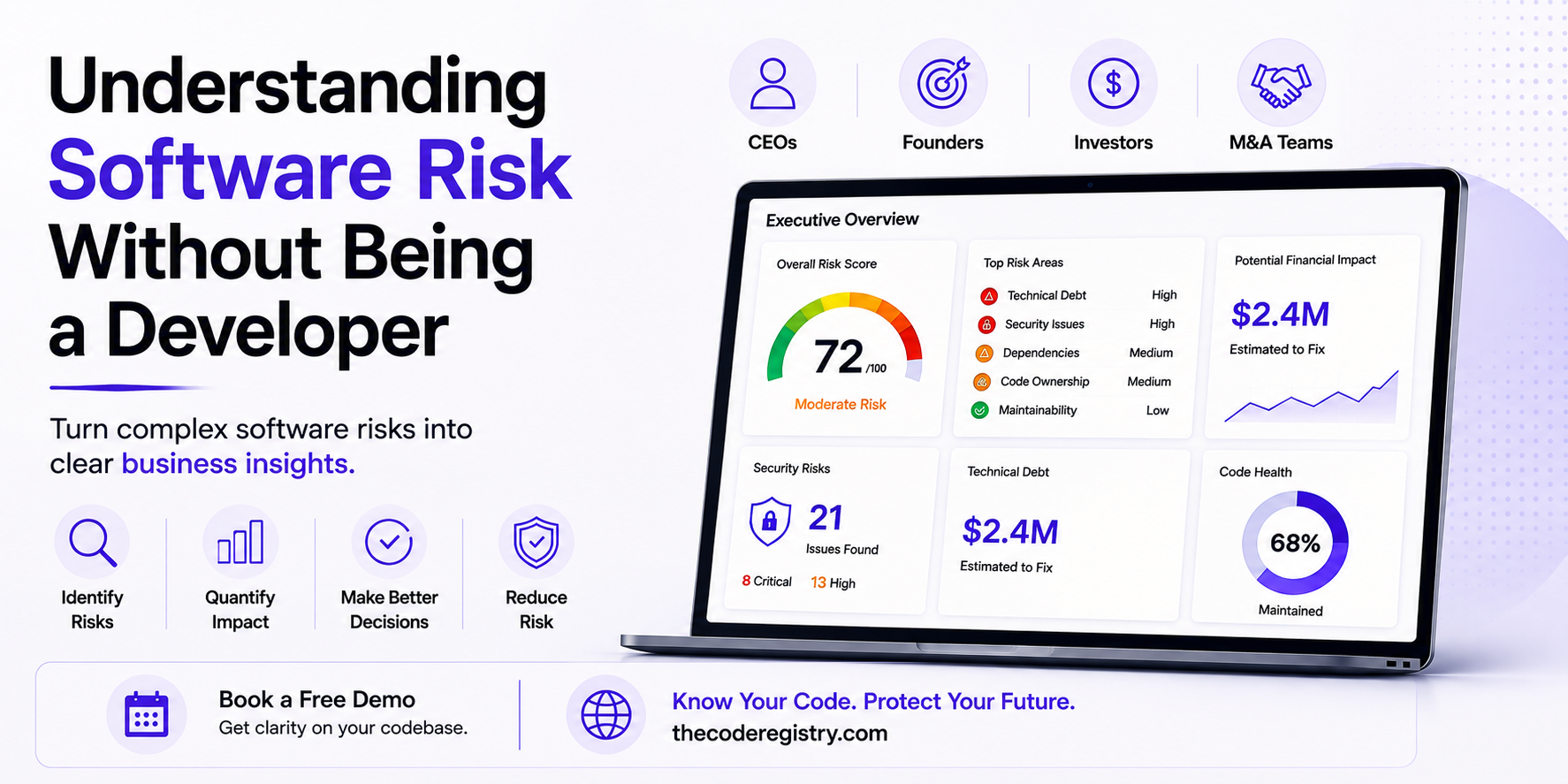
How to Detect Hidden Risks in Third-Party Software
Identify Security, Dependency, Licensing, and Code Risks in Third-Party Software

Modern applications are rarely built entirely from code written by one engineering team.
A typical production application may depend on open-source packages, commercial libraries, cloud services, APIs, container images, build tools, infrastructure components, outsourced modules, and increasingly, code generated or modified with AI coding assistants.
That creates a difficult engineering question:
How do you know what risks are actually inside software you did not build entirely yourself?
The answer is not simply “run a vulnerability scanner.”
A vulnerability scanner can identify known weaknesses. It cannot, by itself, tell you whether a dependency is abandoned, whether the architecture is dangerously coupled, whether critical code has unclear provenance, whether technical debt makes the system difficult to maintain, whether licensing obligations have been understood, or whether AI-generated code introduced assumptions that were never properly validated.
This article presents a practical framework for detecting those hidden risks.
What Is Third-Party Software Risk?
Third-party software risk is the security, architecture, dependency, provenance, licensing, maintainability, operational, and governance risk introduced by software that an organization did not completely develop and control itself. It includes known vulnerabilities as well as unknown risks created by incomplete visibility into code, dependencies, ownership, and software history.
Consider a simple application:
Your Application |
Authentication Library |
Database Driver |
HTTP Client |
Logging Framework |
Cloud SDK |
Transitive Dependencies |
Build Tools |
Container Image
Your team may own the application code, but it does not necessarily control every component represented in that graph.
Third-party software risk therefore has multiple dimensions.
Press enter or click to view image in full size

The important distinction is that software risk is larger than vulnerability risk.
A component can have zero currently known CVEs and still represent substantial enterprise risk.
Why Third-Party Software Contains Hidden Risk Third-party software contains hidden risk because important information often exists outside the source files being reviewed. Dependency graphs, repository history, build pipelines, configuration, licensing, architecture, ownership, and AI-assisted changes can all contain risk signals that conventional security scans do not capture.
Modern software is a supply chain.
An application may contain:
Direct dependencies Transitive dependencies Runtime dependencies Build-time dependencies Container images Infrastructure modules External APIs Commercial SDKs Legacy components Outsourced code AI-generated code AI-assisted modifications A dependency graph can therefore look more like this:
Application |
Library A | | | + - Library C | | | | | + - Library F | | | + - Library D |
Library B |
Library E The developer may have intentionally selected Library A without ever directly selecting Library F.
The developer may have intentionally selected Library A without ever directly selecting Library F.
That matters because transitive dependencies can introduce vulnerabilities, licensing obligations, maintenance problems, and unexpected behavior.
OWASP’s software supply-chain guidance emphasizes dependency management, component inventories, source-control security, build integrity, and monitoring.
Other hidden signals include:
Hard-coded secrets
Insecure defaults
Weak authentication
Poor authorization boundaries
Outdated APIs
Abandoned packages
Excessive code duplication
Poor test coverage
High architectural coupling
Undocumented business logic
Unclear maintainers
Repository fragmentation
License incompatibilities
Build dependencies
Configuration-dependent security behavior
This leads to a fundamental distinction:
No detected vulnerability ≠ no software risk.
A scanner can report what it knows.
Code intelligence must investigate what the scanner does not know.
Why AI-Generated Code Changes Third-Party Software Risk
AI-generated code introduces an additional software assurance problem: organizations must understand not only what code does, but how it was generated, modified, reviewed, and validated. AI coding assistants can produce useful code, but generated code may contain insecure patterns, outdated APIs, incorrect assumptions, unsuitable dependencies, or tests that validate the wrong behavior.
AI-assisted development now covers a broad spectrum:
AI autocomplete
AI coding assistants
AI pair programming
LLM-generated code
Code-generation agents
Autonomous coding agents
Agentic software development
The important point is not that AI-generated code is inherently insecure.
It is not.
The problem is assurance and provenance.
A developer may know that a function was generated by an AI assistant, but six months later that information may not be obvious from the repository.
Consider:
Prompt
↓
AI Model
↓
Generated Code
↓
Developer Modification
↓
AI Modification
↓
Human Review
↓
Automated Tests
↓
Production
The final Git commit may only identify the developer who committed the change.
The repository may not tell you:
Which code was AI-generated
Which code was manually modified
Which model produced it
What assumptions were made
Whether the generated code was independently reviewed
Whether dependencies were introduced automatically
Whether generated tests adequately validate behavior
GitHub’s documentation explicitly recommends applying security safeguards to AI-generated suggestions and notes that generated code can reproduce insecure patterns or outdated APIs.
The correct response is not to ban AI.
It is to add AI-aware assurance.
AI-generated code → AI code audit → code intelligence → software assurance → software governance
How to Detect Hidden Risks in Third-Party Software
Detect hidden third-party software risk through six stages: Discover → Map → Analyze → Validate → Govern → Monitor. The process begins with identifying software assets and dependencies, then evaluates architecture, security, provenance, quality, licensing, and ownership before establishing controls and continuously monitoring changes.
The Six-Stage Framework
┌───────────┐
│ DISCOVER │
└─────┬─────┘
↓
┌───────────┐
│ MAP │
└─────┬─────┘
↓
┌───────────┐
│ ANALYZE │
└─────┬─────┘
↓
┌───────────┐
│ VALIDATE │
└─────┬─────┘
↓
┌───────────┐
│ GOVERN │
└─────┬─────┘
↓
┌───────────┐
│ MONITOR │
└─────┬─────┘
↓
Continuous Software Risk Intelligence

flowchart TD

A[Discover] → B[Map]
B → C[Analyze]
C → D[Validate]
D → E[Govern]
E → F[Monitor]
F → B
1. Discover
Start by finding everything that actually constitutes the software.
Look for:
Repositories
Source code
Binary artifacts
Packages
Services
Infrastructure
Build systems
Licenses
Owners
Deployment environments
If you cannot inventory the software, you cannot reliably assess it.
2. Map
Build a dependency and relationship graph.
Separate:
Direct dependencies
Transitive dependencies
Runtime dependencies
Build dependencies
Infrastructure dependencies
An SBOM is useful here because it provides a structured representation of software components.
But an SBOM is not a complete software risk assessment.
3. Analyze
Evaluate:
Vulnerabilities
Architecture
Code quality
Technical debt
Secrets
Dependencies
Provenance
Licensing
Maintainability
Testing
Documentation
Observability
This is where code intelligence becomes particularly valuable.
4. Validate
A technical finding requires context.
For example, an obsolete library inside a non-critical internal tool may have a very different risk profile from the same library inside an authentication service.
Validate findings against:
Business criticality
Security policies
Architecture standards
Compliance requirements
Availability requirements
Data sensitivity
Recovery requirements
5. Govern
Turn analysis into controls.
Examples include:
Dependency approval policies
Branch protection
CODEOWNERS
Security gates
Secrets policies
Release approval
License policies
Risk acceptance workflows
6. Monitor
Software does not remain static after deployment.
Dependencies change.
Repositories change.
Maintainers leave.
Vulnerabilities are discovered.
Architecture drifts.
Technical debt grows.
AI agents modify code.
Therefore, the assessment must continue.
How AI Code Audits Differ from Traditional Code Reviews
Traditional code review usually focuses on a specific change and asks whether it is correct, secure, readable, and maintainable. An AI code audit expands the scope to the entire codebase, dependencies, provenance, architecture, technical debt, and AI-assisted development history. It complements human review rather than replacing it.
Press enter or click to view image in full size

A traditional review might ask:
· Does this function work?
· An AI-assisted software audit should also ask:
· What does this function depend on?
· Does it violate architectural boundaries?
· Does it introduce a new security pattern?
· Does it increase technical debt?
· Was it generated or modified using AI?
· Is the dependency appropriately governed?
· Can we establish its provenance?
That is a much larger question.
Core Areas Every Third-Party Software Assessment Should Examine
A serious assessment should examine correctness, architecture, security, dependencies, secrets, provenance, licensing, maintainability, testing, documentation, observability, compliance, AI-generated code, technical debt, ownership, repository governance, architecture drift, and inventory. These dimensions should be analyzed together because risk often emerges from their relationships.
Press enter or click to view image in full size

The objective is not to create hundreds of findings but to understand relationships.
For example:
High Coupling
↓
Harder Changes
↓
Slower Remediation
↓
Longer Security Fix Windows
↓
Higher Operational Risk
That relationship is more useful to an engineering leader than a raw “high complexity” finding.
AI Code Audits, DevSecOps, and Software Governance
AI code auditing, DevSecOps, and software governance address different layers of software assurance. AI code audits examine code and AI-assisted risk, DevSecOps integrates security into development and delivery, and software governance establishes policies, ownership, accountability, and risk decisions across the software lifecycle.
Press enter or click to view image in full size

A mature organization should connect these layers:
Code Intelligence
↓
Security + Architecture + Quality
↓
DevSecOps Controls
↓
Governance Policies
↓
Risk Acceptance
↓
Executive Reporting
NIST’s Secure Software Development Framework provides a common vocabulary for secure development practices and can also support software acquisition and supplier communication.
The Enterprise Software Risk Evidence Chain
The Software Risk Evidence Chain connects technical evidence to enterprise consequences: Code → Dependencies → Provenance → Architecture → Security → Quality → Ownership → Governance → Business Risk. It helps teams understand why an apparently minor technical issue can become a significant operational, financial, legal, or strategic risk.
CODE
↓
DEPENDENCIES
↓
PROVENANCE
↓
ARCHITECTURE
↓
SECURITY
↓
QUALITY
↓
OWNERSHIP
↓
GOVERNANCE
↓
BUSINESS RISK

flowchart LR

A[Code] → B[Dependencies]
B → C[Provenance]
C → D[Architecture]
D → E[Security]
E → F[Quality]
F → G[Ownership]
G → H[Governance]
H → I[Business Risk]
Consider an unknown dependency.
At first, it may look like a simple inventory problem.
But:
Unknown Dependency
↓
Unknown Maintainer
↓
Delayed Security Patch
↓
Production Exposure
↓
Operational Risk
↓
Business Continuity Risk
SLSA uses provenance to describe information about where and how software artifacts were produced, helping organizations establish stronger relationships between source, build processes, and resulting artifacts.
The concept is important because provenance changes the question from:
“We believe this artifact came from our build process.”
to:
“We have evidence describing how this artifact was produced.”
Enterprise Risks of Shipping Unassessed Third-Party Software
Shipping unassessed third-party software can create supply-chain, dependency, architecture, compliance, licensing, operational, and ownership risks. The most difficult category is unknown risk: situations where an organization cannot establish sufficient evidence about what software contains, where it originated, who controls it, or whether it remains suitable for its intended purpose.
Known risk is easier to manage.
You can assign an owner, create a remediation ticket, and establish a deadline.
Unknown risk is different.
Examples include:
Unknown software provenance
Unknown dependencies
Unknown ownership
Unknown license obligations
Unknown AI-generated code
Unknown architecture constraints
Unknown build inputs
This creates an evidence gap.
CISA positions SBOMs as an important mechanism for software transparency and supply-chain visibility, but SBOM consumption is part of a broader software supply-chain risk-management process.
Major risk categories include:
Software supply-chain attacks
Dependency compromise
Architecture drift
Shadow AI
Prompt injection
Prompt poisoning
Compliance failures
Insecure configuration
Technical debt
License exposure
Unsupported software
Vendor concentration
Ownership ambiguity
Common Mistakes Organizations Make
Organizations often underestimate third-party software risk by treating popularity, open-source status, SBOM availability, vulnerability scans, or developer familiarity as proof that software is trustworthy. Each provides useful evidence but answers only one part of the risk question. Effective assessment combines security, architecture, provenance, dependencies, licensing, ownership, and maintainability.
Press enter or click to view image in full size

A particularly dangerous assumption is:
“The software has been running for years, so it must be safe.”
Age proves only that software has existed.
It does not prove:
Maintainability
Security
Current dependency health
Architecture quality
License compliance
Provenance
Ownership
Building an AI-Assisted Software Assurance Program
An AI-assisted software assurance program combines secure SDLC practices with AI-use policies, repository governance, dependency management, SBOMs, provenance, secrets management, automated testing, static and dynamic analysis, AI code review, and human approval gates. The goal is not to eliminate AI-generated code but to ensure its risks remain observable and governable.
A practical implementation can use five layers.
1. AI Development Policy
Define:
Approved AI tools
Data-handling rules
Source-code confidentiality
Human review requirements
AI-generated code disclosure where appropriate
Model and agent permissions
2. Repository Governance
Use:
Branch protection
CODEOWNERS
Least-privilege access
Pull-request requirements
Audit trails
Secret scanning
3. Dependency Governance
Implement:
SBOM generation
Dependency inventories
Version policies
Vulnerability monitoring
License policies
Abandoned-package detection
4. Software Assurance
Combine:
SAST
DAST
SCA
Secrets detection
Automated testing
Architecture analysis
Provenance verification
AI code analysis
5. Human Accountability
Automated tools can detect.
They cannot independently decide whether a business should accept a risk.
Human owners should therefore remain accountable for:
Risk acceptance
Exceptions
Production approval
Architecture decisions
Security decisions
Future Outlook: From Code Review to Continuous Software Intelligence
Software assurance is moving from periodic code review toward continuous software intelligence. Autonomous coding agents, AI-assisted DevSecOps, platform engineering, software provenance, policy as code, continuous inventories, and automated technical-debt analysis are increasing the need for software systems that can continuously understand and evaluate code changes.
The transition looks like this:
Periodic Code Review
↓
Automated Security Scanning
↓
Continuous Dependency Analysis
↓
Continuous Code Intelligence
↓
Continuous Software Assurance
The key change is not simply automation.
It is continuous context.
An organization should increasingly be able to answer:
· What changed?
· What dependencies changed?
· What architecture changed?
· What security risk changed?
· What technical debt changed?
· What ownership changed?
· What AI-assisted changes occurred?
· What policy was affected?
· What business systems are impacted?
Hashnode itself reflects the broader shift toward developer-focused AI and engineering workflows, with its current publication ecosystem emphasizing AI coding, agents, and developer tooling.
At the same time, Hashnode has introduced structured data, canonical URLs, and newer AEO capabilities, reinforcing the importance of structured technical content for both search engines and AI answer systems.
For engineering organizations, the larger trend is:
Code Review → Code Intelligence → Software Intelligence → Continuous Software Assurance
Key Takeaways Hidden third-party software risk is best detected by connecting code, dependencies, provenance, architecture, security, quality, ownership, and governance. Enterprises should combine SBOM and supply-chain controls with code intelligence, AI code assurance, technical-debt analysis, architecture assessment, and continuous monitoring.
Third-party software risk is broader than vulnerability risk. A clean vulnerability scan does not prove software is healthy. Dependencies must be understood as a graph, not merely a package list. SBOMs improve visibility but do not replace software due diligence. Software provenance provides evidence about software origin and production. AI-generated code creates an additional assurance and provenance dimension. Architecture risk can remain significant even when vulnerability counts are low. Technical debt directly influences future software ownership cost. Licensing and ownership belong in technical due diligence. Continuous monitoring is more valuable than a single point-in-time assessment. Conclusion Third-party software should be evaluated as an enterprise asset and risk surface rather than simply as source files and dependencies. A reliable assessment connects security, architecture, provenance, technical debt, licensing, ownership, maintainability, AI-generated code, and governance to determine whether software remains fit for its intended purpose.
The question should no longer be:
“Does this software contain vulnerabilities?”
The better question is:
“What evidence do we have that this software is secure, maintainable, governable, explainable, and fit for its intended purpose?”
That distinction matters when organizations:
Acquire software Inherit applications Outsource development Integrate commercial components Adopt open-source dependencies Build with AI coding assistants Deploy autonomous coding agents Modernize legacy systems Evaluate software during M&A The Code Registry’s code-intelligence and software-governance approach provides one example of how organizations can connect technical evidence with architecture, technical debt, provenance, ownership, and executive software risk.
The practical next step is not necessarily another security scanner.
It is building an evidence model that can answer:
What do we have?
Where did it come from?
What does it depend on?
How is it structured?
Who owns it?
How maintainable is it?
How was it secured?
Which parts were AI-generated or AI-assisted?
What risks are known?
What risks remain unknown?
The most dangerous software risk is not necessarily the vulnerability an organization can see.
It is the risk the organization lacks the evidence, provenance, intelligence, or governance capability to see.
Frequently Asked Questions
1. What is third-party software risk?
Third-party software risk is the possibility that software developed outside an organization’s complete control introduces security, dependency, architecture, licensing, provenance, maintainability, operational, or governance exposure.
It applies to commercial software, open-source libraries, outsourced code, inherited applications, cloud components, and AI-assisted development.
2. How do you assess third-party software risk?
Assess third-party software through six stages: discover the software, map dependencies, analyze code and architecture, validate findings against business requirements, establish governance controls, and continuously monitor changes.
This creates a lifecycle rather than a one-time security review.
3. What should a software due diligence review examine?
A software due diligence review should examine source code, architecture, dependencies, security, technical debt, licensing, provenance, testing, documentation, ownership, maintainability, infrastructure, and operational constraints.
The objective is to determine both current exposure and future ownership cost.
4. What is an AI code audit?
An AI code audit is a software assurance assessment that uses automated intelligence and human expertise to analyze code, dependencies, architecture, security, provenance, technical debt, and AI-assisted development signals.
It complements conventional code review rather than replacing it.
5. How should enterprises review AI-generated code?
AI-generated code should pass through normal secure-development controls plus additional provenance and AI-governance checks.
Organizations should use automated testing, security analysis, dependency analysis, human review, licensing processes, and appropriate repository controls.
6. What are the biggest risks of third-party dependencies?
Major risks include vulnerable packages, compromised dependencies, abandoned projects, transitive dependencies, outdated versions, license obligations, malicious packages, and unclear ownership.
The important point is that dependency risk includes both security and lifecycle risk.
7. Is an SBOM enough to assess software supply-chain risk?
No. An SBOM provides important visibility into software components, but it does not independently establish architecture quality, code security, provenance, ownership, licensing compliance, or business fitness.
An SBOM should be one input into a broader software assurance process.
8. How does software provenance reduce enterprise risk?
Software provenance provides information about where software came from and how an artifact was produced.
This helps organizations establish stronger traceability between source code, build systems, dependencies, and deployed artifacts.
9. What is the difference between code review and software due diligence?
Code review usually focuses on a particular code change.
Software due diligence evaluates the broader software asset, including architecture, dependencies, security, technical debt, provenance, licensing, ownership, maintainability, and operational risk.
10. How can enterprises continuously monitor software risk?
Enterprises can continuously monitor software risk by combining dependency intelligence, vulnerability monitoring, code analysis, secrets detection, provenance, architecture analysis, repository governance, technical-debt tracking, and change monitoring.
The results should feed remediation and governance workflows.
Glossary
Press enter or click to view image in full size